
BIG IDEA:
HOW DO YOU KNOW YOU HAVEN’T BEEN LEFT BEHIND?
THE REVEALING OF THE ANTICHRIST MUST PRECEDE THE DAY OF THE LORD.
INTRODUCTION:
Have we missed the boat? Are we as believers somehow already in the Day of the Lord and experiencing that special time of intensified wrath of God? Certainly we are experiencing a high level of suffering and persecution (in the early church). What are we to make of these difficult times? The Apostle Paul was writing to the Thessalonian believers to calm their fears and prevent further deception.
You must have a proper systematic understanding of eschatology in order to understand Paul’s argument in this text. Remember the timeline for the Pre-Wrath Rapture view:
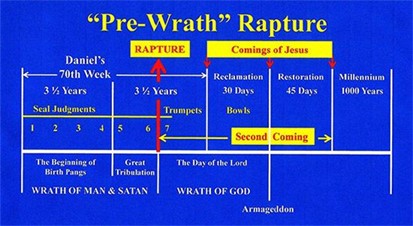
This differs dramatically from the Pre-Trib position which would not make sense here. Also you must understand the nature of the 70th week of Daniel which includes both a period after the mid-point identified as the Great Tribulation (which believers will experience) and then the Rapture of believers followed by the Day of the Lord, the time of the outpouring of God’s wrath on unbelievers culminating in the Battle of Armageddon.
Michael Martin: Taking 2:1–15 as a unit, we find that the first two verses of the chapter introduce the primary concern—attempts to delude the church regarding the time of the parousia. Verses 3–10 provide proofs indicating that the day of the Lord could not have yet arrived. The proofs of vv. 3–4 and 8–10 (derived largely from the OT) are interrupted by a Pauline parenthesis (vv. 5–7) reminding the Thessalonians that Paul taught them these things previously. Verses 5–7 highlight especially his earlier teachings that the parousia was being delayed until the appropriate time. Verses 11–15 contrast the dangers of succumbing to delusion and the blessings of holding to the truth, delivering a final encouragement to the church to stand firm in the apostolic traditions. The message of 2:1–15 then called forth a concluding prayer (vv. 16–17) requesting God’s encouragement and assistance that the Thessalonians might indeed remain firm in the faith.
I. (:1-3a) DON’T BE DECEIVED ABOUT THE ORDER OF END TIME EVENTS
A. Primary Issue = Timing of the Rapture at Christ’s Second Coming (Parousia)
“Now we request you, brethren, with regard to:
the coming of our Lord Jesus Christ
and our gathering together to Him”
One of the main purposes of the Second Coming of Christ is the rapture of believers.
Grant Osborne: The issue clearly relates to the timing of the parousia. The Jewish people expected one “coming” of the Messiah, and it was intimately connected to the restoration of the nation, often called their “regathering” (Ps 106:47; Isa 27:13; 52:12; Zech 2:7). Jesus spoke of this regathering in connection with his own parousia (Matt 24:31; 25:31–32). Paul clearly picked up on Jesus’ teaching in his many references (1 Thess 2:19; 3:13; 4:15; 2 Thess 1:7, 10).
Timothy Brookins: The term “gathering” (episynagōgē) echoes the prophetic prediction that God would regather the Jews of the dispersion into Palestine (Ps. 106:47 [105:47 LXX]; Isa. 27:13; Ezek. 28:25; Zech. 2:6–7; Tob. 14:7; 2 Macc. 1:27; 2:7–8). The NT appropriates this word to refer to the gathering of the church at the parousia (Matt. 24:31; Mark 13:27; cf. Apoc. Ab. 31.1). In 1 Thessalonians the gathering at the parousia is clearly described as a resurrection (4:14, 16; cf. 4:17). Here, the use of a single definite article to coordinate “parousia” and “gathering” suggests, likewise, that the two actions are part of a single event.
B. Pastoral Intent (Motivation) = Need to Stay Calm and Level-Headed
-
- “that you may not be quickly shaken from your composure”
2. “or be disturbed”
C. Primary Indicator in Question = Relationship between the Rapture and the Day of the Lord
“to the effect that the day of the Lord has come”
The Day of the Lord refers to that aspect of the Second Coming that is characterized by divine wrath and judgment.
D. Possible Indoctrination Methods
- Prophetic Utterance
“either by a spirit”
Someone claiming to be passing along a prophetic word from the spirit
Michael Martin: The first source mentioned, “by prophecy” (dia pneumatos), is literally “by spirit.” It probably refers to a Spirit-inspired utterance of some sort with emphasis on the revelatory nature of the utterance. Prophecy, interpreted tongues (cf. 1 Cor 14:5,12), or any other exercise by which a speaker claimed to guide the church by Spirit-inspired insight could serve as the specific avenue of the teaching. Paul warned the church against the error of either dismissing such spiritual teachers out of hand or accepting their words uncritically (cf. 1 Thess 5:19–22; 1 Cor 14:36–37). The apostolic teaching regarding the day of the Lord in vv. 3–15 (also that in 1 Thess 4:13–5:11) is the kind of information the church could use to evaluate teachings claiming spiritual authority.
- Public Teaching
“or a message”
- Personal Letter
“or a letter as if from us”
Marvin Rosenthal: The Thessalonians were greatly disturbed by false teachers who were communicating erroneous doctrine concerning end time events. This false teaching, according to the apostle, was being propagated in three ways: “by spirit” (prophetic utterance), “by word” (some spoken teaching), and by forged documents attributed to the apostle Paul (“by letter as from us,” 2 Thess. 2:2). The core of that false teaching was imbedded in the statement “that the day of the Lord is present.”
Michael Martin: If forgeries existed in the first century, how would the church know a particular letter was genuinely from Paul? Three ways are indicated in the Thessalonian correspondence. First, the carrier of a letter was a guarantor of its authenticity. Timothy, known and trusted by both the church and the apostle, apparently served as the courier between the apostle and the Thessalonians (1 Thess 3:1–3,6). The carrier of a letter in antiquity commonly served as the envoy of the sender. He both delivered the document and if necessary interpreted the intent of the author. Often, as in the case of Timothy, the letter carrier also returned with a verbal or written reply.
A second assurance of genuineness was the signature of the author. Correspondence often was produced by an amanuensis, the first-century version of a personal secretary (cf. Rom 16:22). The amount of freedom allowed the amanuensis was determined by the person using his services. When it was deemed necessary, the author of the correspondence wrote a final word and in this way “signed” the letter personally. Second Thessalonians 3:17 is an example of just such a practice (cf. Gal 6:11; 1 Cor 16:21).
The third assurance of authenticity was the content of the letter itself. The teachings and the lifestyle of the apostle were known to the churches he established. Paul on occasion appealed to this knowledge as a guide for the believers (cf. 2:5; 3:7; 1 Thess 1:5). Teachings that were at odds with those they had from the apostle in person were to be rejected (cf. Gal 1:8–9). Even so in this instance the events Paul cited that would precede the parousia were not new to the church, as Paul reminded them (v. 5).
E. Precursor Identification = Protection from Deception
- Danger of Deception
“Let no one in any way deceive you,
- Definitive Precursor to the Day of the Lord
“for it will not come unless the apostasy comes first …”
Marvin Rosenthal: The phrase falling away (2 Thess. 2:3) is a translation of the Greek word apostasia. It means a defection, revolt, or apostasy. It signifies a falling away or total abandonment of something or someone. It is used only twice in the entire Word of God; therefore, how it is used becomes exceedingly important. Dr. Luke used the word apostasy in describing an important occasion when the apostle Paul met with the Jewish elders at Jerusalem. Many Jews had accepted Christ, but they continued to adhere to the old covenant and the Mosaic Law (Acts 21:20). They wanted to believe in Jesus, but within Old Testament Judaism. They did not comprehend that Jesus had initiated a new covenant. . . It is used in the context of the apostle Paul being repudiated for supposedly asking Jews to renounce Moses, circumcision as the basis of covenantal relationship, and the Jewish customs.
When Paul used the word apostasy in 2 Thessalonians 2:3, he did so in exactly the same way as Dr. Luke. He was speaking of Jews who, during the seventieth week of Daniel, will totally abandon the God of their fathers and their messianic hope in favor of a false religion (humanism) and a false messiah (the Antichrist, 2 Thess. 2:2-12).
This view is in marked contrast with the general view of pretribulation rapturism. The usual position is that Paul was speaking of believers in this age who will apostatize before the Rapture and the beginning of the seventieth week. . .
The Bible teaches that the apostasy and revealing of the man of sin must precede the Day of the Lord. The Apostasy and revealing of the man of sin occur within the seventieth week. Therefore, the Day of the Lord cannot begin before the first five seals are broken or at the beginning of the seventieth week. . .
The apostasy will occur during the first three and one-half years of Daniel’s seventieth week, and then, in the middle of the week, the Antichrist will be revealed to the Jewish people. That event will trigger a period of such severity that unless those days were cut short, no flesh (again in context, Jewish) would live.
The issue at hand, and which to this author is undeniably clear, is that the apostasy and revealing of the man of sin to Israel must occur inside the seventieth week, not before it begins. That a remnant of godly believers will recognize the Antichrist when the covenant is made is certainly true and consistent with the teaching of the Lord (Matt. 24:33; cp. vv. 4-28) and the apostle Paul (1 Thess. 5:4-6). But what Paul is teaching is that Israel, the nation with whom the covenant is made, will not recognize the Antichrist until the abomination of desolation occurs in the middle of the week. According to the apostle Paul, the Day of the Lord judgment must take place after those events. Therefore, the Day of the Lord cannot commence at the beginning of the seventieth week, and the Rapture, which occurs at the very outset of the Day of the Lord, cannot possibly be pretribulational.
Michael Martin: The Thessalonians were not to allow anyone to deceive them regarding the presence of the day of the Lord. That day has not arrived unless certain observable events have taken place. The rebellion must occur, and the man of lawlessness must be revealed (v. 3). The revelation of this man follows the removal of the restrainer (vv. 7–8) and precedes the day of the Lord (v. 8). If the man of lawlessness has not been revealed, then the day of the Lord cannot have arrived. . .
It is possible that the coming of the lawless one does not follow the apostasy but is coincident with it or even antecedent to it. If either is the case, than we probably should understand the deception of vv. 9–10 (produced by the lawless one) as the engine driving the apostasy. The apostates in such a scenario would have been those who fell away from the worship of the true God in favor of following the deceiver. If Paul was expanding on Jewish apocalyptic thought, these who apostasize would most logically be Jews, not pagans (since pagans have no relationship from which they could apostatize). But the church also expected an unusually difficult time near the end of the age when false teachers would entice many of its members to desert the apostolic faith for more palatable but false teachings (Matt 24:11–13; 1 Tim 4:1–5; 2 Tim 3:1–9; Jude 17–19). Paul also, though he expressed confidence that all the elect will be saved, allowed for the possibility of some in the church deserting it (1 Thess 3:5). Thus it seems likely that the apostasy Paul had in mind expanded on Jewish apocalyptic expectations and envisioned a dramatic and climactic falling away from the worship of the true God (by both Jews and some portion of the Christian church) as a part of the complex of events at the end of the age.
Grant Osborne: So Paul is describing the final rebellion that will pave the way for the coming of the man of lawlessness. It involves the rejection of God and Christ, and people turning themselves over to the cosmic powers behind this figure. In other words, it is first a rebellion against God and second an apostasy from the true religion.
G.K. Beale: The apostasy will not occur primarily in the non-Christian world but rather within the covenant community, as is clear from four observations.
(1) A “falling away” assumes some sort of prior turning to God.
(2) This is consistent with the above-noted usage of apostasia in the Old Testament.
(3) It is also consistent with the immediate context of deception within the church.
(4) It is supported by the closest verbal parallel to this passage, namely, Martyrdom of Isaiah 2:4-5, where “the angel of iniquity” empowers evil Manasseh “in causing apostasy [apostasia], and in the lawlessness [anomia] that was disseminated in Jerusalem,” that is, among God’s people.
II. (:3b-4) THE REVELATION OF THE ANTICHRIST WILL BE IMPOSSIBLE TO MISS
A. Rebellious Character of the Antichrist Will Be Blatantly Obvious
“the man of lawlessness is revealed”
Michael Martin: The same verb, apocalypt , is used for the revelation of Jesus in 1:7. The repetition of the verb may imply that the man of lawlessness will be a pseudo-messiah (cf. Matt 24:4). This impression is strengthened with subsequent references to his “coming” (parousia) in v. 9a; the miracles, signs, and wonders that support his claims (v. 9b); and his assumption of the place and title of deity (v. 4). Those who are not deceived by him will recognize that he is not the Christ but is anti-Christ (cf. 1 John 2:18; 4:1–3). He will be a deceptive and satanic opponent of the true Christ who will ultimately destroy the pretender at the genuine parousia (v. 8).
B. Destructive Agenda of the Antichrist Will Be Blatantly Obvious
“the son of destruction”
John MacArthur: Human history has had its share of evil leaders … But one is coming who will surpass them all, both in the extent of his power and the evil of his person. He will be the most fiendish, wicked, powerful man ever to walk the earth. He is known in Scripture by many names; he is “Gog of the land of Magog, the prince of Rosh, Mesheck and Tubal” (Ezek. 38:2); the little horn of Daniel 7:8, 24; 8:9; the “prince who is to come” (Dan. 9:26); the king who does as he pleases (Dan. 1:36); the foolish, worthless shepherd (Zech. 11:15-17); the beast (Rev. 11:7; 13:1; 14:9; 19:20; etc.).
C. Sacrilegious Actions of the Antichrist Will Be Blatantly Obvious
- General Description of Usurption of Worship
“who opposes and exalts himself
above every so-called god or object of worship”
Grant Osborne: The opening description is the key. He is the enemy of all that is good and “opposes” everything that has anything to do with God, and he is the epitome of arrogance, “exalting himself” over everything that is of God. Both are comprehensive and concern “everything that is called God or is worshiped.” In other words, his entire purpose is to lead all the world in rejecting God and replacing him with himself as the pretentious claimant to deity. In Revelation 13:2–8 the dragon (Satan) gives the beast (the antichrist) his own power and authority (not God’s!), and he uses that authority to get all the earth-dwellers (the sinners) to worship him. This is exactly the picture here, as this lawless one/anti-christ supplants not only the one God of the Jews and Christians but all the gods of the pagan world as well. His goal is to be recognized by all religions as the god of all. This goes beyond the imperial cult, which made the emperor one of the gods. He will come across (and actually pull it off!) as the goal of all of earth’s religions, and for this brief period he will actually unite all the religious longings of every religion in himself.
- Ultimate Display of Sacrilegious Blasphemy
“so that he takes his seat in the temple of God”
- Primary Objective
“displaying himself as being God”
Grant Osborne: This builds on Daniel 11:36, which predicts a future king who will “exalt and magnify himself above every god” (see also Ezek 28:2–10). This picture of an apostate king who makes the Jerusalem temple his throne room was first fulfilled in Antiochus Epiphanes, who thought himself to be the son of Zeus and caused the Maccabean revolt by setting up altars to Zeus in the temple (and villages of Israel) in 167 BC.
III. (:5) DON’T BE FORGETFUL ABOUT YOUR FORMER COURSE IN ESCHATOLOGY
“Do you not remember that while I was still with you,
I was telling you these things?”
Michael Martin: The things they already knew were sufficient to refute this false teaching about the day of the Lord. “I used to tell you these things” translates an imperfect verb tense that implies ongoing or recurring instruction. “These things” (the teachings of vv. 3–4) were not presented only once, a situation that might excuse the Thessalonians’ failure to remember them. Rather, they were matters addressed repeatedly (and presumably in far greater detail than was recorded here), and the church should have remembered them.